Artificial Turf in Tucson What Holds Up in Desert Heat
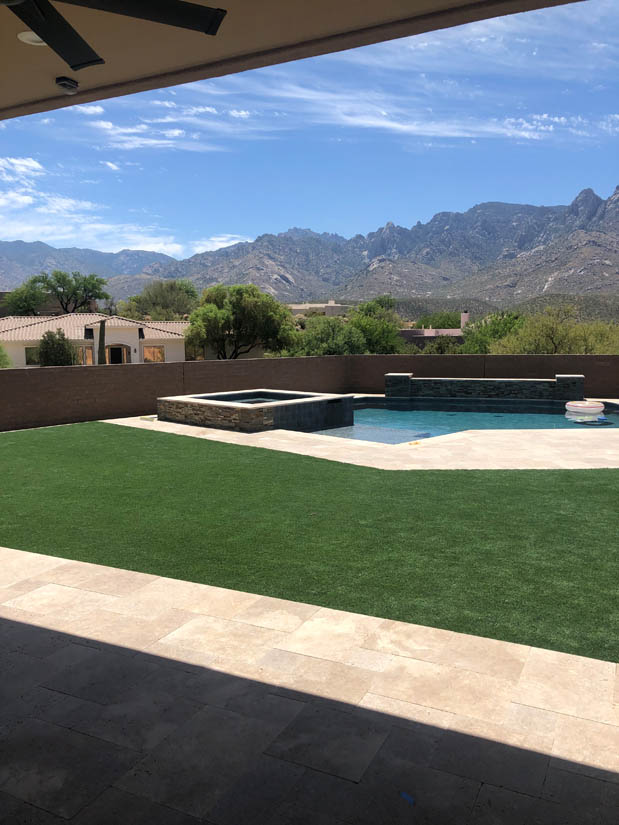
Artificial turf is one of the few landscaping decisions in Southern Arizona where the wrong choice shows itself fast. A lawn that looked perfect in November can be flattened, faded, and rippling by the second summer if the product grade was wrong or the base underneath it was rushed. Done properly, the same square footage stays green through 115 degree afternoons, drains during a monsoon downpour, and still looks like a lawn a decade later.
This guide walks through what artificial turf actually is, why Tucson punishes it harder than almost anywhere else in the country, how a real installation is built from the ground up, and what drives the cost of the finished job. We install turf across Tucson, Oro Valley, Marana, Sahuarita, Vail, Green Valley, and Catalina, and most of what follows comes from watching what survives here and what does not.
Why Tucson Homeowners Are Replacing Live Lawns
The push toward artificial grass in Southern Arizona is not fashion. It is arithmetic and frustration, and it usually comes down to five things.
Water
A live lawn in Tucson is a summer irrigation project. Bermuda demands frequent deep watering through the hottest months, and overseeding with rye to keep winter color means running water in the shoulder seasons too.
Dormancy
Even a well kept Bermuda lawn goes brown for months. Homeowners who want year round green end up on an annual overseeding treadmill.
Dust and Allergens
Bare and thinning turf areas turn into dust sources, and that dust ends up on patios, pool decks, and inside the house.
Monsoon Damage
Storm runoff scours weak grass, washes out soil, and leaves low spots that hold water and breed mosquitoes.
Maintenance Load
Mowing, edging, fertilizing, aerating, and treating a lawn through a Tucson summer is real work in real heat.
Artificial turf trades all of that for a different set of tradeoffs: a bigger day one investment, a product that has a finite lifespan, and a surface that gets hot in full sun. Whether it is the right call depends on how the space is used and how well it is installed.
How Artificial Turf Is Actually Built
Every turf product is a manufactured textile, and the specification sheet tells you more than the showroom sample does. These are the components that decide how it performs.
Face Fiber
The blades themselves are extruded polyethylene, nylon, or polypropylene. Polyethylene is the standard for residential lawns because it is soft and holds a natural sheen. Nylon is stiffer and more heat resistant, which is why it shows up in putting greens and heavy traffic areas. Polypropylene is the least durable and belongs in low use applications only. Blade shape matters as much as the material: a flat ribbon blade lays over quickly, while shaped blades with a spine or a W profile resist matting and stand back up under foot traffic.
Pile Height and Face Weight
Pile height is how long the blades are, usually between one and two inches for a residential lawn. Longer is not better. Tall pile with light density lays over and looks tired within a season. Face weight, measured in ounces per square yard, describes how much yarn is actually in the product. Two turfs with the same pile height and very different face weights will not age the same way.
Stitch Rate and Gauge
Stitch rate is how many tufts are sewn per length of row, and gauge is the spacing between rows. Together they set density. A dense turf hides the backing, supports the blades so they stand upright, and holds infill in place. Thin turf reveals the backing under sunlight and traffic.
Backing and Drainage
The primary backing holds the tufts, and a secondary coating locks them in. In Arizona the backing choice matters because it is exposed to enormous thermal cycling. Perforation pattern controls how fast water leaves the surface. A fully perforated backing drains storm water across the whole field rather than pushing it to seams and edges, which is exactly what you want in a monsoon climate.
Thatch Layer
Most quality turf includes a shorter, curled secondary yarn at the base, often in tan or olive. That thatch layer mimics the dead growth in a live lawn, supports the taller blades, and helps hide the infill.
- Color and gloss
Darker, higher gloss fiber absorbs more solar energy. Lighter blends with a matte finish run cooler. - Infill choice
Crumb rubber absorbs and holds heat aggressively. Silica sand and coated sand products run cooler, and some infills are specifically engineered to hold moisture and release it during peak sun. - Shade
This is the single biggest lever. Turf under a mesquite, a shade sail, or an Alumawood cover is dramatically cooler than turf in open western exposure. - Rinsing
A short hose down drops surface temperature immediately, though the effect fades quickly in dry desert air. - Layout
Placing turf where the house or a wall shades it during afternoon peak, and using pavers or travertine for full sun zones, solves the problem through design rather than product.
UV Degradation and Why Warranties Differ Here
Tucson averages far more sun hours than most of the country, and ultraviolet exposure is what eventually kills synthetic turf. UV breaks down the polymer chains in both the fiber and the backing. The visible symptoms are fading, a chalky surface feel, blades that snap instead of bending, and backing that becomes brittle and cracks around seams and stakes.
Quality turf includes UV inhibitors compounded into the yarn rather than applied as a surface treatment. That is a manufacturing difference you cannot see or feel in a two inch sample, which is why product selection should be based on the specification sheet and the manufacturer warranty terms, not on how a swatch feels in your hand.
Read warranty language carefully. Coverage periods, what counts as excessive fading, whether labor is included, and whether the warranty survives a transfer of ownership all vary between manufacturers. A warranty on a bargain product that fades in five years is not equivalent to a warranty on a product engineered for desert exposure.
Base Construction: The Part That Decides Everything
Almost every failed turf lawn we are called out to look at failed underneath, not on top. The turf itself is usually still fine. The base moved, drained poorly, or was never compacted properly. Here is what a correct installation involves in Tucson soil.
Demolition and Excavation
Existing grass, roots, and soil have to come out, typically three to four inches, more for heavy use or dog areas. Roots left in place decompose and create voids that show up as dips a year later.
Caliche
Southern Arizona soils frequently include caliche, a cemented hardpan layer that does not absorb water. Where caliche sits close to the surface, water perches on top of it instead of soaking away. That has to be addressed during excavation, either by breaking through it, adding depth for drainage aggregate, or routing water to a place it can actually go.
Aggregate and Compaction
A base of crushed aggregate, commonly a mix graded to lock together under compaction, is installed in lifts and compacted with a plate compactor. Compacting in a single deep pass does not work. Each lift needs its own pass. Proper compaction is what prevents settling, and settling is what creates the visible waves and low spots that make a lawn look cheap.
Grading and Drainage
The base is graded with intentional slope away from the house and toward an outlet. Turf drains vertically through its perforations, but the water still has to leave the site. In a monsoon climate, an installer who does not plan where the water goes has only moved the problem.
Weed Barrier
A geotextile weed barrier goes between the soil and the base or between the base and the turf, depending on the detail. It suppresses growth from below while still allowing water through. Windblown seed can still germinate in the infill on top, which is why occasional spot treatment remains part of maintenance.
Edging and Anchoring
Perimeters get secured with bender board, concrete edging, or by tucking the turf against existing hardscape. Edges are anchored with landscape spikes or nails at a spacing tight enough to hold through thermal expansion. Turf expands and contracts significantly across a Tucson temperature swing, and under anchored edges lift.
Seaming
Turf comes in rolls of a fixed width, so most lawns have seams. Every roll must be laid with the grain running the same direction or the seam will read as a color change. Seams are joined with seam tape and adhesive, not just stapled together. A well made seam is invisible. A bad one is the first thing anyone sees.
Infill
Infill is brushed into the fibers to weight the turf down, hold blades upright, protect the backing from UV, and give the surface a natural feel underfoot. Under filled turf mats down early and never recovers.
Infill Types Compared
| Infill Type | How It Behaves in Tucson | Best Use |
|---|---|---|
| Rounded silica sand | Inexpensive, stable, cooler than rubber, can compact over time | General residential lawns |
| Acrylic coated sand | Coating resists compaction and microbial growth, holds up well to heat | Family lawns and higher traffic areas |
| Antimicrobial or zeolite blend | Captures ammonia from pet urine and releases it during rinsing | Dog runs and pet areas |
| Crumb rubber | Adds cushion, absorbs and retains significant heat | Sports and play surfaces, generally not our first choice in full desert sun |
| Organic infill | Retains moisture and can cool the surface, needs replenishment and can break down | Shaded areas where cooling is the priority |
Pet Turf: What Changes When Dogs Use the Lawn
Turf Handles Dogs Well When It Is Specified for It
Dogs are one of the most common reasons Tucson homeowners switch to turf, because live grass in a dog yard becomes dirt and mud fast. Turf handles dogs well when it is specified for it.
Routine is simple: pick up solids, rinse the area regularly, and use an enzymatic turf cleaner periodically. In Tucson heat, regular rinsing is the difference between a fresh yard and a yard you smell before you see.
Turf vs. Sod vs. Desert Landscaping
Artificial turf is not the automatic answer. Some yards are better served by sod, and many are better served by desert planting with decomposed granite and hardscape. Here is an honest comparison.
| Factor | Artificial Turf | Live Sod | Desert Landscaping |
|---|---|---|---|
| Water use | Occasional rinsing only | Highest of the three, year round | Low, drip irrigation for establishment and plants |
| Ongoing maintenance | Brushing, rinsing, infill top off | Mowing, fertilizing, aerating, overseeding | Periodic pruning, granite refresh, drip repairs |
| Year round appearance | Consistent green | Dormant and brown in winter unless overseeded | Seasonal, plant dependent |
| Summer surface comfort | Hot in full sun, comfortable in shade | Coolest surface of the three | Granite gets very hot |
| Lifespan | Many years with proper base and product | Indefinite with continuous inputs | Long, with plant replacement over time |
| Best fit | Play areas, dog yards, small usable green space | Homeowners who want a true living lawn | Large areas and low use zones |
Most of the Tucson yards we design use more than one of these. A compact turf area where the family actually walks and plays, pavers or travertine where people sit and grill, and desert planting for everything else, is a combination that uses less water than a full lawn while still giving you real green.
What Drives the Cost of a Turf Installation
We do not publish prices, because a per square foot number quoted without seeing a yard is close to meaningless. What we can do is tell you exactly which variables move a turf estimate, so you can read any bid you receive with clear eyes.
Square Footage
Larger areas spread mobilization and setup across more surface, so unit cost typically drops as the area grows.
Demolition
Removing an existing lawn, old rock, concrete, or roots adds labor and haul off. A bare dirt starting point is the simplest.
Access
If a machine can reach the yard, base material moves quickly. If everything has to travel by wheelbarrow through a narrow gate, labor hours climb.
Soil Conditions
Caliche, buried debris, and existing drainage problems all add excavation work.
Base Depth
Deeper and more heavily compacted bases cost more and are worth it. This is the line item people cut and then regret.
Product Grade
Face weight, fiber type, UV package, and warranty all sit behind the price of the roll itself, and the spread between economy and desert grade turf is substantial.
Shape Complexity
Curves, tree wells, planter cutouts, and multiple small areas mean more cutting, more seams, and more waste.
Seams and Roll Direction
An awkward layout can force extra material to keep the grain consistent.
Edging and Transitions
Concrete edging, bender board, or tying into an existing paver patio each carry their own cost.
Slopes and Terracing
Sloped installs require additional anchoring and sometimes retaining work.
Add Ons
Drainage systems, irrigation cap off, low voltage lighting, and pet specific infill each change the total.
When comparing bids, compare base depth, aggregate type, compaction method, infill type and quantity, seam method, and the turf specification sheet. If two bids differ significantly, the difference is almost always hiding in one of those lines.
Where Turf Is the Wrong Choice
We would rather talk a homeowner out of turf than install it somewhere it will disappoint them.
- Deep shade under dense trees: Turf works fine there, but falling leaves, seed pods, and sap create constant cleanup, and mesquite pods in particular are a chore.
- Large open areas with no functional use: If nobody walks on it, desert landscaping usually looks better, costs less, and never needs replacing.
- Steep slopes: These areas need proper anchoring and drainage detail.
- Fire pits, grills, or reflective glass: Synthetic fiber melts. Concentrated reflected light off low emissivity windows has been known to scorch turf, and embers will leave permanent marks.
- Unresolved drainage problems: Fix the water first. Turf laid over a spot that ponds will just be a green spot that ponds.
Common Installation Failures We Get Called to Fix
| What You See | Likely Cause |
|---|---|
| Wrinkles and ripples | Almost always insufficient compaction, turf that was not allowed to acclimate and relax before it was cut and secured, or inadequate perimeter anchoring. |
| Visible seams | Rolls laid with opposing grain direction, or seams joined without proper tape and adhesive. |
| Matted, laid over blades | Under filled infill, a product with too little density for the traffic it gets, or no brushing maintenance. |
| Infill migration | Infill washing to low spots during monsoon storms because the grade or the perimeter detail was wrong. |
| Edge lift | Too few anchors, or anchors set too far apart to handle thermal expansion in a climate with a wide daily temperature swing. |
| Standing water | Base graded flat or sloped toward the house, or a caliche layer that was never addressed. |
| Weeds through the surface | Missing or torn weed barrier, or seed germinating in organic debris left sitting on the infill. |
Some of these are repairable in place. Wrinkles and edge lift can often be corrected. Base failures usually mean pulling the turf, redoing the base, and relaying it, which is why the base is where the money should go the first time.
Maintaining Artificial Turf in Southern Arizona
- Brush the fibers against the grain periodically with a stiff bristle push broom or a power broom, especially in the paths people walk most.
- Rinse the surface to clear dust, pollen, and pet residue. In Tucson, dust is constant and rinsing is the main upkeep task.
- Blow or rake off leaves, mesquite pods, and palo verde litter before they break down into the infill.
- Top off infill every few years, and sooner in high traffic zones. Infill is consumable.
- Spot treat any weeds that appear along edges and in the infill.
- Keep grills, fire pits, and any hot metal off the surface.
- Inspect edges and seams after major monsoon storms, along with the rest of your drainage.
Designing Turf Into the Rest of the Yard
The best turf installations do not look like a green rectangle dropped into the desert. They look like part of a plan.
Transitions
A clean edge where turf meets a paver patio, travertine deck, or poured concrete walkway is what separates a professional install from a DIY one. Those transitions get detailed during design, not improvised on install day.
Surface Strategy
Use turf where feet go, hardscape where furniture and traffic go, and granite and plantings for the rest.
Shade
Trees, shade sails, and covered patios make turf usable in summer and extend its life by cutting UV exposure.
Lighting
Low voltage landscape lighting along a turf edge or up into nearby trees makes the space usable in the evening, which in Tucson is when people are actually outside for much of the year.
Drainage
Grading, French drains, dry creek beds, and channel drains should be laid out before the base goes in, not retrofitted after the first storm finds the low spot.
Frequently Asked Questions
Select a question below to expand the answer.
How long does artificial turf last in Tucson?
A quality, UV stabilized product on a properly built base commonly gives many years of service in Southern Arizona, though intense sun exposure here is harder on turf than in milder climates. The two things that shorten lifespan most are a cheap product with a weak UV package and a base that was never compacted correctly.
How hot does artificial turf get in the Arizona sun?
Noticeably hotter than live grass and hotter than shaded pavers, because synthetic fiber cannot transpire. Lighter matte fiber, a cooler infill, shade, and a quick rinse all reduce it. If a space is used at mid afternoon in July, design shade into it.
Does artificial turf drain during monsoon storms?
Yes, when it is built correctly. Water passes through the perforated backing, moves through the compacted aggregate base, and exits along the graded slope. Turf laid over undressed caliche or flat grading will hold water no matter how good the product is.
Is artificial turf good for dogs?
It works very well for dogs when the product and infill are chosen for pet use. You need high drainage backing, a permeable base, an odor controlling infill, and a routine of picking up solids and rinsing regularly.
Do weeds grow through artificial turf?
Rarely from below when a weed barrier is installed. What does happen is windblown seed germinating in organic debris sitting on top of the infill, which is handled by keeping the surface clear and spot treating occasionally.
Can artificial turf be installed over existing concrete?
Yes, with a proper pad or drainage layer and adhesive detailing, provided the concrete drains and does not pond. It is a common solution for small courtyards and side yards.
How much does artificial turf cost in Tucson?
It depends on square footage, demolition, access, soil conditions, base depth, product grade, and edging. That is why we walk the yard before quoting. When comparing bids, look at base depth, compaction, infill, seam method, and the turf specification sheet rather than the bottom line alone.
Is artificial grass better than sod in Tucson?
It depends on how you use the space. Turf wins on water use, consistent appearance, and low maintenance. Sod wins on summer surface comfort and the feel of a living lawn. Many yards here do best with a small turf area, hardscape for entertaining, and desert planting elsewhere.
When is the best time of year to install turf in Tucson?
Fall through spring is the most comfortable window for the crew and the easiest scheduling, which is why the calendar fills up after monsoon season. Turf can be installed year round, and summer installs are perfectly workable with earlier start times.
Do I need to remove my irrigation system?
Not necessarily. Irrigation serving planting beds usually stays and gets adjusted. Lines under the turf area are capped or rerouted during excavation so nothing is left leaking under the base.
Talk to a Tucson Turf Installer Who Builds the Base Right
Acevedo Desert Green Landscaping is a family owned Tucson landscaping company with more than 20 years in Southern Arizona and over 3,120 completed projects. We install artificial turf, pavers and patios, travertine, concrete, sod, and landscape lighting throughout Tucson, Oro Valley, Marana, Sahuarita, Vail, Green Valley, and Catalina. Because we build hardscape and drainage as well as turf, we plan the whole yard together, which is how the transitions come out clean and the water ends up where it should.
If you are weighing artificial grass for your yard, we will walk the property, look at the soil, the sun exposure, and the drainage, and give you a straight answer about whether turf is the right surface for that space. Browse our gallery to see finished projects, then call (520) 631-0099 or reach us through our contact page to schedule a walkthrough.
Written by the team at Acevedo Desert Green Landscaping, family owned in Tucson for over 20 years and more than 3,120 completed projects across Southern Arizona.


