
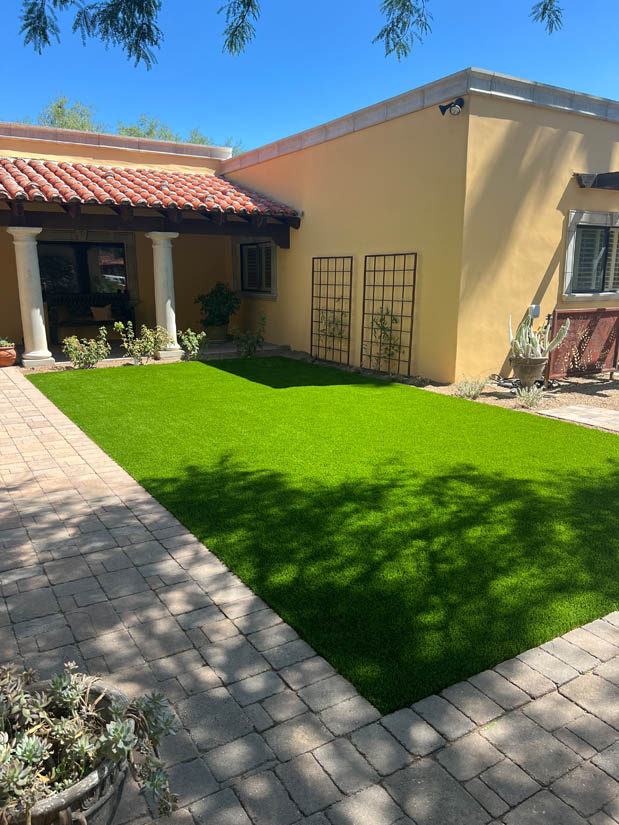
Monsoon-Proofing Your Tucson Yard Drainage, Paver Patios & Retaining Walls That Survive Storm Season
Build hardscape that moves monsoon water on purpose. Learn how Tucson soil, grading, paver bases, drainage systems, and retaining walls work together before the next storm cell arrives.
Every summer, Southern Arizona goes from bone dry to flash flood in about twenty minutes. A monsoon cell parks over the Catalinas, drops an inch of rain in half an hour, and the water it sends downhill does not politely soak into your yard. It runs. It carves channels through decomposed granite, pushes soil out from under patio slabs, pools against foundations, and turns a carefully designed backyard into a mud flat before the storm has even cleared Marana.
The homeowners who come through monsoon season without damage are almost never the ones who got lucky. They are the ones whose hardscape was built to move water somewhere on purpose. That is the difference between a patio that lasts twenty years and one that starts settling after its second summer.
This guide walks through what monsoon water actually does to a Tucson property, why the soil here makes it worse, and how pavers, grading, drainage systems, and retaining walls work together to keep a yard intact. Whether you are in Oro Valley, Sahuarita, Vail, Green Valley, or central Tucson, the physics are the same and so are the fixes.
What Monsoon Season Actually Does to a Tucson Yard
Monsoon damage is rarely one dramatic event. It is a series of small failures that compound over several storms, and most of them start with water moving faster than the ground can absorb it.
Sheet Flow
Rain arrives faster than the soil can take it in, so it spreads across the surface in a thin, fast-moving layer that picks up everything loose in its path.
Erosion & Washout
Decomposed granite, gravel, and topsoil migrate downhill, leaving bare low spots and burying plants, drains, and lawn edges under displaced material.
Undermining
Water finds a path beneath a concrete slab or paver field and carries the base material out from underneath it. The surface looks fine until it drops.
Pooling at the House
Yards that slope the wrong way send water toward the foundation, where it sits against the stem wall and works into the slab edge.
Joint Washout
On paver patios built without proper joint stabilization, storm flow strips sand out of the joints, and the pavers begin to shift and rock.
Slope Failure
On properties with grade changes, saturated soil gets heavy, loses friction, and starts to move. This is how retaining walls lean and eventually fail.
The frustrating part is that the damage almost never shows up during the storm. It shows up in October when the patio has a dip in it, or two summers later when a wall is visibly out of plumb.
Why Southern Arizona Soil Makes It Worse
Drainage advice written for the rest of the country does not translate here, because Tucson soil does not behave like soil in a place that gets steady rain.
Caliche
Caliche is a cemented layer of calcium carbonate that sits under a huge portion of the Tucson basin, sometimes a few inches down, sometimes a few feet. It is functionally a rock shelf. Water that soaks in stops when it hits caliche and then travels sideways along the top of that layer. If that lateral path runs toward your patio base or your foundation, you have a drainage problem that no amount of surface landscaping will fix.
Low Infiltration & Hardpan
Desert soils that go months without rain develop a crusted, compacted surface. When the first big cell of the season hits, that crust sheds water almost like pavement. The ground is not absorbing anything for the first several minutes of a storm, which is exactly when flow rates peak.
Decomposed Granite & Ground Cover
DG is the default ground cover across Southern Arizona and it is beautiful, but it is also loose aggregate sitting on a slope. Without edging, stabilization, or a designed flow path, monsoon runoff moves it into the street, into pool equipment, and into every low corner of the yard.
Expansive Clay Pockets
Parts of the region carry clay that swells when it finally gets wet and shrinks back as it dries. That cycle lifts and drops whatever is built on top of it, which is a slow but reliable way to crack a rigid concrete slab.
- Where does water enter the property?
Look at the neighbor’s grade, the street, the roof scuppers, and any wash or easement bordering the lot. - Where does it collect?
Standing water more than a day after a storm marks a low spot or a spot where infiltration has stopped at caliche. - Where does it exit?
Every yard needs an outlet. If you cannot name yours, water is leaving through a place you did not choose. - What does the stain line tell you?
Silt lines on walls, fences, and stem walls show exactly how deep the water got and how far it spread. - Are there signs of undermining?
Hollow sound underfoot, a gap under a slab edge, or a step that has separated from a patio are all warnings. - Is the grade sloping away from the house?
Ground should fall away from the foundation over the first several feet in every direction.
Why Pavers Outperform Poured Slabs in Storm Season
Both concrete and pavers have a place in a Tucson yard, and Acevedo Desert Green Landscaping installs both. But when the design problem is water, pavers have structural advantages that are hard to argue with.
| Factor | Paver Patio | Poured Concrete Slab |
|---|---|---|
| Water handling | Joints and base allow water through or across; permeable options move it into a storage layer | Sheds all water to the edges, concentrating flow at slab perimeter |
| Movement | Flexible field of individual units absorbs soil movement without cracking | Rigid monolith; soil movement transfers directly into cracks |
| Repairability | Individual units lift out and reset; base can be corrected in a small area | Cracks are patched or the section is removed and repoured |
| Settling | Re-levelable by relaying affected pavers on corrected base | Settled slab typically requires lifting or replacement |
| Failure mode | Gradual and visible: joints open, units rock | Sudden and structural: cracks propagate across the pour |
Paver Advantage
A paver field is designed to move with the ground and be taken apart. If a localized area settles, the affected units can be lifted, the base corrected, and the surface reset.
Permeable systems go further by using wider joints and an open-graded stone reservoir to store the front end of a storm surge.
Where Concrete Still Makes Sense
Poured concrete is excellent for driveways with heavy vehicle loads, utilitarian side yards, equipment pads, and long straight runs where cost efficiency matters more than flexibility.
The rule of thumb: concrete for load and simplicity, pavers where water, movement, and future access are the design drivers.
Base and Bedding: The Reason Installs Fail
Almost every failed paver patio in Tucson failed below the pavers, not at them. The visible material is the least important part of the installation.
Excavation Depth
The base has to be dug deep enough for the intended use. A pedestrian patio and a driveway that carries vehicle loads are not the same excavation.
Subgrade Preparation
The native soil at the bottom of the excavation gets compacted before anything goes on top of it. Skipping this guarantees future settling.
Geotextile Fabric
A separation fabric between subgrade and aggregate keeps fines from migrating up into the base and keeps the base from sinking into soft soil.
Aggregate Base in Lifts
Base rock goes in and gets compacted in layers, not dumped in one thick pile and rolled once.
Bedding Layer
A thin, screeded layer of coarse sand or chip that the pavers set into. It should never be used to fix a bad base.
Edge Restraint
Without a solid restraint around the perimeter, the entire field creeps outward over time and the joints open up.
Joint Sand
Polymeric or stabilized joint material locks the field together and resists washout in heavy flow.
When you compare bids for pavers in Tucson, the real difference often lives underneath the surface. Two proposals can specify the same paver and describe entirely different structures below it.
Grading and Slope: Getting Water Somewhere on Purpose
Drainage design is mostly an exercise in deciding where water goes, then making the ground agree.
- Positive slope away from structures: Water should never be encouraged to sit near a stem wall, garage slab, or casita foundation.
- Continuous fall: Water needs an uninterrupted downhill path from where it lands to where it leaves. A single flat section becomes a pond.
- A designated outlet: Every drainage plan ends somewhere: a street, wash, dry well, bioswale, or designed low area meant to hold water briefly.
- Respect neighbors and code: Concentrating flow onto an adjacent lot creates a legal problem in addition to a neighborly one.
- Pitch patio surfaces: A patio that reads as flat to the eye should still fall gently away from the house.
Drainage Systems That Pair With Hardscape
Grading handles the broad strokes. These systems handle the water that grading alone cannot move.
French Drain
Perforated pipe in gravel collects subsurface water and carries it to an outlet.
Best when: Chronic soggy areas, water traveling along a caliche shelf, or water behind a wall.
Channel Drain
A linear surface grate intercepts sheet flow across a hard surface.
Best when: Across a driveway, at a patio-and-house transition, or at a garage apron.
Catch Basin
A boxed inlet at a low point captures pooled water into a pipe.
Best when: Yard low spots and downspout collection points.
Dry Well
A buried gravel or chamber reservoir holds water and lets it infiltrate.
Best when: Lots with no gravity outlet available or where storm-surge storage is needed.
Dry Creek Bed
A designed rock channel carries and slows visible surface flow.
Best when: Sloped yards where flow is unavoidable and can be made attractive.
Bioswale or Basin
A shallow planted depression slows, holds, and infiltrates runoff.
Best when: Water harvesting and desert planting areas.
The best designs combine several systems. A Vail property on a slope might use a dry creek bed to move visible flow, a channel drain where that flow crosses the driveway, and a dry well at the bottom because there is nowhere downhill to send it.
Retaining Walls as Erosion Control on Tucson Slopes
Water Behind the Wall Is the Real Threat
On a graded lot, a retaining wall is not decoration. It is the thing holding a hillside in place, and monsoon season is when it gets tested. Walls fail for one reason more than any other: water trapped behind them.
- Drainage behind the wall: Clean gravel backfill gives water a place to go instead of pressing against the structure.
- Weep holes or drain pipe: A perforated collection pipe at the base relieves hydrostatic pressure.
- Geotextile separation: Fabric keeps fines from clogging the drainage layer.
- Proper footing: Below-grade footing must be sized for wall height and soil conditions.
- Reinforcement and engineering: Taller walls and walls holding a real load need structural design and often permitting.
- Terracing: Two shorter walls with a planted bench often outperform one tall wall and drain better.
Common Monsoon Failures and What Actually Caused Them
| What You See | Likely Cause |
|---|---|
| Patio has developed a dip or low spot | Base material washed out beneath it, or subgrade was never compacted |
| Pavers rock underfoot and joints are open | Joint sand washed out and edge restraint is missing or failed |
| Water stands near the back door after storms | Grade slopes toward the structure, or the yard has no outlet |
| Retaining wall is leaning outward | No drainage behind the wall; saturated soil is pushing on it |
| Cracks radiating across a concrete slab | Soil movement below combined with missing or misplaced control joints |
| DG washed into the street after every storm | No edging, no stabilization, and no designed flow path on the slope |
| Gap under the patio edge or step | Active undermining; water is running below the surface |
Post-Storm Inspection Checklist
Walk the property the morning after a significant cell. Ten minutes now can save a much larger repair later.
- Check the stem wall and the base of the house for silt lines and standing moisture.
- Look for new low spots or areas where the ground sounds hollow underfoot.
- Inspect paver joints for sand loss and check whether any units rock when stepped on.
- Clear catch basins, channel drains, and drain outlets of leaves, gravel, and displaced DG.
- Sight along retaining walls for bulges, new cracks, or a change in lean.
- Note where DG and gravel moved, since that traces the storm’s actual flow path.
- Confirm downspouts and scuppers still discharge where they were designed to.
- Photograph anything that changed so you can compare after the next storm.
Timing a Project Around Monsoon Season
Southern Arizona monsoon season generally runs from mid June into September, which shapes when this work is best scheduled across Tucson, Oro Valley, Marana, Sahuarita, Green Valley, Vail, and Catalina.
Build Before the Storms
The strongest window for installing drainage and hardscape ahead of the first major cells.
Observe the Water
The best time to document flow paths and handle urgent repairs to failing walls or undermined patios.
Prime Build Season
The most comfortable build season in Southern Arizona and one of the busiest, so early consultations help secure better calendar slots.
Plan and Permit
A strong season for design and permitting so installation can begin before the next monsoon cycle.
If you already know a specific area of the yard floods every single year, that project belongs at the front of the list. Recurring water damage compounds, and each season makes the eventual repair larger.
Frequently Asked Questions
Select a question below to expand the answer.
Do pavers drain better than concrete in Tucson?
Yes, in most yard applications. A paver field lets water move through the joints and into the base rather than sheeting off the surface, and permeable systems go further by storing storm water in an open-graded stone reservoir. Concrete sheds all of its water to the edges, which concentrates flow exactly where you least want it.
Will a paver patio wash out during a monsoon storm?
A correctly built one will not. Washout happens when joint sand is loose, the edge restraint is missing, or the base was under-compacted. Stabilized joint material, a solid perimeter restraint, and a properly layered compacted base are what hold the field together under heavy flow.
What is caliche and why does it matter for drainage?
Caliche is a hardened calcium carbonate layer under much of the Tucson basin. It acts like rock, so water that soaks in stops at that layer and travels sideways instead of continuing down. Drainage design has to account for where that lateral flow goes, which is why excavation depth and subsurface drains matter so much here.
How do I know if my yard has a real drainage problem?
Water standing more than about a day after a storm, silt lines on the stem wall, ground cover migrating into the street every summer, and any hollow spot or gap under a patio edge are all clear signals. If the grade near the house is flat or falls toward the structure, that alone is worth addressing.
Can a retaining wall fail from a single storm?
Failure usually builds over multiple seasons of saturated soil pressing on a wall with no way to relieve the water, then becomes visible after one heavy storm. Gravel backfill, a drain pipe at the base, and separation fabric are what prevent it. A wall already leaning or bulging should be evaluated before the next season.
Should I regrade my yard or install drains?
Usually both, in that order. Grading is the foundation of any drainage plan because it establishes where water naturally wants to travel. Drains handle what grading alone cannot, particularly subsurface water on a caliche shelf and flow crossing hard surfaces.
Are permeable pavers worth it in the desert?
In yards with a runoff or infiltration problem, yes. The open-graded base under a permeable system acts as short-term storage for the front end of a storm, which is when flow rates are highest and when most surface damage happens. It also supports water harvesting into planting areas.
Can drainage work be done during monsoon season?
Yes. Urgent repairs and drainage corrections are done year round, and mid season is actually useful for diagnosis because the water shows you exactly where it goes. Larger hardscape installations are typically scheduled around the heaviest storm windows.
Do I need a permit for a retaining wall in the Tucson area?
It depends on wall height, load, and the jurisdiction. Requirements differ between the City of Tucson, unincorporated Pima County, Oro Valley, and Marana, and many HOAs add their own review. Confirm requirements before design so engineering and approvals are built into the schedule.
How long does a properly built paver patio last in Southern Arizona?
With a correct base, edge restraint, and maintained joint material, a paver patio is a long-term installation, and individual units can be lifted and reset if the ground shifts. That repairability is the practical advantage over a slab, which has to be patched or replaced when it cracks.
Monsoon-Proof Your Tucson Yard Before the Next Storm Season
Monsoon season is not an unusual event in Southern Arizona. It is a scheduled annual stress test, and a yard either passes it every year or slowly loses ground to it. Grading, base construction, drainage systems, and wall design are the parts of a project nobody photographs and the parts that determine whether the beautiful surface on top is still level in ten years.
Acevedo Desert Green Landscaping is a family owned outdoor living and hardscape specialist with more than 20 years of experience in Southern Arizona and over 3,120 completed projects across Tucson, Oro Valley, Marana, Sahuarita, Green Valley, Vail, and Catalina. Our work spans pavers and patios, travertine, artificial turf, landscape lighting, and concrete services, which means a drainage plan and the hardscape sitting on top of it get designed together instead of separately.
If your yard flooded this summer, if a patio has started to settle, or if a wall is not sitting the way it used to, that is information worth acting on before the next season.


